
Bain Capital’s Acquisition of esure Group
Deal Overview
Acquirer: Bain Capital Private Equity (United States)
Target: esure Group plc (United Kingdom)
Transaction Value: £1.21 billion
Offer Price: 280 pence per share (all-cash)
Structure: Public-to-private acquisition
Mechanism: Court-sanctioned scheme of arrangement
Governing Law: Companies Act 2006
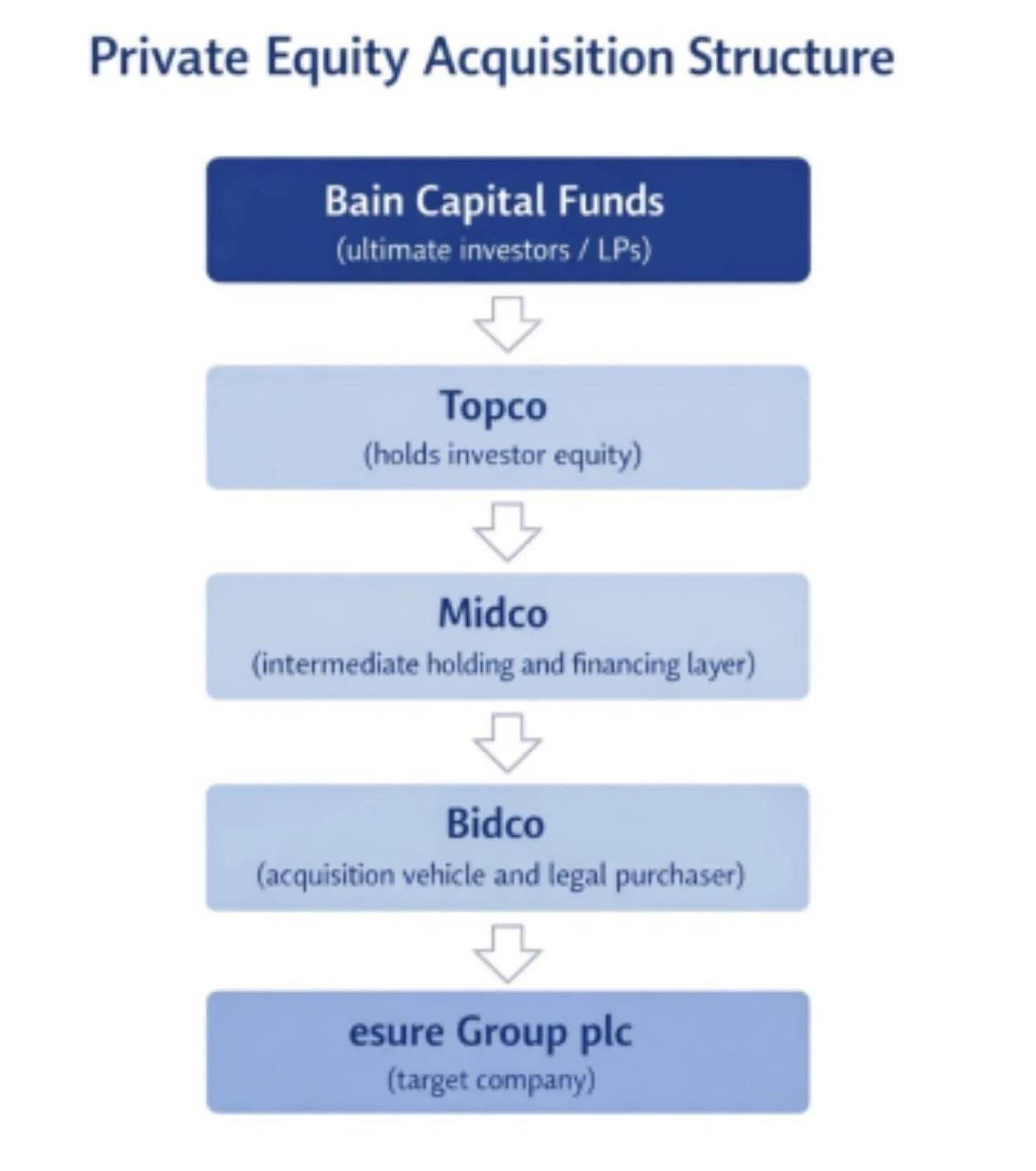
The Figure above illustrates the private equity acquisition structure adopted in this transaction, showing the flow of investor capital from Bain Capital’s funds through the Topco, Midco and Bidco entities to esure Group plc. This structure is commonly used in private equity take-private transactions to facilitate acquisition-level leverage, ownership consolidation, and ring-fencing of operational risk, which is particularly relevant in regulated financial services acquisitions.
Key Deal Timeline
June 2018: Bain Capital announces a recommended all-cash offer for esure at 280 pence per share.
July 2018: esure shareholders approve the proposed scheme of arrangement at a Court Meeting and General Meeting.
30 November 2018: The Financial Conduct Authority (FCA) and Prudential Regulation Authority (PRA) grant change-in-control approvals.
December 2018: The High Court of England and Wales sanctions the scheme under Part 26 of the Companies Act 2006.
December 2018: The scheme becomes effective; esure is delisted from the London Stock Exchange and becomes a privately held company.
This transaction brought together a well-established UK personal lines insurer with one of the world’s most sophisticated private equity investors, executed through established UK corporate law mechanisms and financial-sector regulatory frameworks.
Company Details: Acquirer — Bain Capital (United States)
Founded: 1984
Founders: Mitt Romney, T. Coleman Andrews III, Eric Kriss
Headquarters: Boston, Massachusetts
Key Managing Partners (at time of deal): Jonathan Lavine, Steven Barnes
Industry: Private equity and alternative investments
Bain Capital was founded in 1984 by former Bain & Company partners, initially applying consulting-driven insight to identify underperforming businesses with potential for operational improvement. Over time, the firm evolved from a traditional leveraged buyout model into a transformation-focused private equity investor, emphasising long-term value creation rather than short-term financial engineering.
This evolution has been driven by Bain’s focus on operational transformation, technology adoption, and data-driven efficiency. Bain has invested in businesses where value creation depended on modernising legacy systems, improving pricing and analytics capabilities, and strengthening governance structures. A notable example is Bain’s acquisition of Virgin Australia out of administration in 2020, followed by a multi-year operational and digital transformation that culminated in a successful relisting in 2023 at an enterprise value of approximately A$3.5 billion.
Bain’s strategy in financial services reflects this same long-term approach. Over several decades, the firm has invested in asset managers, specialty lenders, payments companies, and insurers, recognising that regulated, data-rich businesses often require patient capital and sustained operational investment to unlock value.
Insurance companies present both opportunities and challenges for private equity investors. They benefit from predictable premium-based revenue streams and extensive customer and claims datasets, but frequently operate legacy IT systems and face strict regulatory oversight. Bain Capital’s established experience with regulated financial services businesses positioned it to assess and manage these challenges effectively.
At the time of the offer, public sentiment around insurers was mixed. Incumbents—large, established insurers characterised by scale, diversified risk pools, and entrenched market positions—were being evaluated through the twin lenses of regulatory reform and intense price competition. Bain’s private equity model offered the ability to navigate these pressures over a multi-year time horizon without the short-term performance constraints imposed by public markets.
Company Details: Target — esure Group plc (United Kingdom)
Founded: 2000
Founder: Sir Peter Wood
CEO (at time of deal): Colin Walsh
Industry: UK personal lines insurance (motor and home)
esure Group plc was established at the turn of the millennium by Sir Peter Wood, the original founder of Direct Line. The business was designed as a direct-to-consumer insurer, using digital distribution channels and lean operating models to compete with legacy insurers reliant on broker-based sales.
The company carved out a niche as a technology-enabled alternative to traditional insurers. Early growth was driven by consumer adoption of online insurance distribution and price comparison websites. esure’s corporate structure supported multiple brands, including Sheilas’ Wheels, which targeted female drivers, and First Alternative, which focused on higher-risk segments. This brand-led structure enabled esure to segment risk pools, tailor pricing strategies, and manage underwriting risk more precisely across different customer demographics.
esure’s public listing on the London Stock Exchange, following its admission to the LSE Main Market (premium listing) on 27 March 2013, provided capital for expansion but also exposed the company to the volatility and scrutiny of public markets. Competitive intensity in UK motor and home insurance increased significantly, driven by price comparison websites and aggressive discounting models. Regulatory interventions further shaped the landscape, particularly initiatives aimed at tackling “price-walking”, whereby loyal existing customers were charged higher renewal premiums than new customers.
The FCA’s pricing practices market study identified price-walking as widespread across the sector, leading to reforms implemented in 2021 that required insurers to offer renewing customers prices equivalent to those offered to new customers. For esure, which relied heavily on pricing segmentation and renewal strategies, these reforms reduced pricing flexibility and placed downward pressure on margins, necessitating further investment in pricing systems, governance processes, and customer communications.
Simultaneously, insurers faced rising claims costs, particularly in motor insurance, where increasing vehicle repair costs and personal injury claims contributed to loss-ratio pressure. esure responded by investing in pricing data, claims analytics, customer service platforms, and risk-modelling capabilities. However, executing such transformation while managing public shareholder expectations created strategic constraints, making private equity ownership increasingly attractive.
Legal & Regulatory Contentions
Scheme of Arrangement under the Companies Act 2006 (Part 26)
A defining legal feature of this transaction was its implementation through a scheme of arrangement under Part 26 of the Companies Act 2006. For a scheme to be effective, it must be approved by a majority in number representing at least 75% in value of shareholders voting at a court-convened meeting and be sanctioned by the High Court of England and Wales.
By contrast, a contractual takeover offer relies on shareholder acceptance levels and only enables compulsory acquisition of minority shares once the bidder reaches a 90% acceptance threshold under Part 28 of the Act. These compulsory squeeze-out rights allow an acquirer to force remaining shareholders to sell but introduce execution risk if the threshold is not achieved.
Schemes provide greater certainty because, once sanctioned, they bind all shareholders. The High Court’s role is supervisory rather than commercial, focusing on statutory compliance, fairness, and proper class constitution. Case law such as Re Anglo American Insurance, Re Telewest Communications, and Re T&N illustrates the courts’ consistent approach to sanctioning schemes where procedural requirements are satisfied.
Financial Services Regulation – Change of Control
As esure operated regulated insurance businesses, Bain Capital’s acquisition triggered change-in-control approval requirements under the Financial Services and Markets Act 2000. Any person acquiring control of an authorised insurer must obtain prior approval from the FCA and the PRA.
The FCA focuses primarily on conduct risk, consumer protection, and market integrity, while the PRA assesses prudential soundness, capital adequacy, governance arrangements, and the insurer’s ability to meet policyholder obligations. Private equity acquirers are subject to particular scrutiny due to concerns around leverage and dividend extraction.
Approval granted on 30 November 2018 without publicly disclosed conditions therefore signalled regulatory confidence in Bain Capital’s financial resources, governance approach, and long-term ownership strategy. Regulatory clearance represented a critical gating item for the transaction, and its absence of conditions materially de-risked the acquisition.
Success of the Deal
From an execution perspective, the Bain Capital–esure acquisition represents a successful UK public-to-private transaction. The coordinated use of a scheme of arrangement and regulatory approvals delivered execution certainty without delay, litigation, or shareholder dissent.
Under private ownership, esure was able to pursue multi-year operational initiatives, including enhanced pricing analytics, automation within claims handling, and modernisation of underwriting and customer engagement platforms. Bain ultimately exited the investment through a sale to Ageas for approximately £1.295 billion, representing an uplift on the original acquisition price and evidencing successful value creation.
For esure’s public shareholders, the transaction delivered immediate cash value at a premium to the undisturbed share price, allowing them to exit an investment affected by regulatory headwinds and sector-wide margin pressure.
Opportunities and Risks: Private Equity Trends in UK Insurance
Private equity interest in UK insurance increased particularly in the early 2020s, driven by the sector’s stable cash flows and transformation potential. Sponsors such as Bain Capital, Cinven, and CVC targeted insurers and insurance-adjacent businesses with strong brands but under-invested infrastructure.
Opportunities in the sector include operational efficiency gains through automation, advanced data analytics for pricing optimisation, and improved customer retention through digital engagement. Developments such as artificial intelligence in claims processing, telematics-based underwriting, and enhanced consumer-centric regulation have reshaped competitive dynamics.
Risks include ongoing regulatory intervention, claims inflation, and the complexity of modernising legacy systems. Private equity sponsors increasingly view these risks as manageable through disciplined capital investment, governance enhancement, and long-term strategic planning.
Conclusion
Bain Capital’s acquisition of esure demonstrates how private equity can deploy patient capital, technological investment, and regulatory expertise to unlock value in a mature and highly regulated sector. The transaction illustrates the alignment of legal structuring, regulatory navigation, and operational transformation in achieving a successful public-to-private outcome.
References
Company & Deal Details
esure Group plc – Update on Recommended Cash Acquisition (Scheme circular)esure’s announcement of the transaction and scheme terms including £1.21bn total, 280p per share, and Part 26 scheme structure.→ https://www.esuregroup.com/media/nniiyvbt/update-on-recommended-cash-acquisition.pdf
esure Group plc – Scheme of Arrangement Effective Notice (Dec 2018)Confirms court sanction and effectiveness of scheme and delisting timeline.→ https://www.esuregroup.com/media/eg4b12gq/scheme-of-arrangement-becomes-effective-19-december-2018.pdf
Reuters – Bain Capital to take UK insurer esure private (14 Aug 2018)Deal announcement, offer price, deal value, and strategic context.→ https://www.reuters.com/article/world/bain-capital-to-take-uk-insurer-esure-private-in-121-billion-deal-idUSKBN1KZ0HJ
Regulatory Approvals and Legal Structure
esure Group plc – Regulatory Approvals Announcement (30 Nov 2018)Public notice confirming FCA and PRA change-in-control approvals.→ https://www.esuregroup.com/media/bcpiutsb/announcement-of-results-of-regulatory-approvals-30-november.pdf
UK Companies Act 2006 (Legislation.gov.uk) – Part 26 Schemes of ArrangementStatutory reference for scheme of arrangement mechanics and approval thresholds.→ https://www.legislation.gov.uk/ukpga/2006/46/part/26
UK Companies Act 2006 – Part 28 Squeeze-Out Rights (for comparison)Shows statutory context for compulsory acquisition when 90% thresholds are met.→ https://www.legislation.gov.uk/ukpga/2006/46/part/28
UK Financial Services and Markets Act 2000 (FSMA) – Change of ControlFramework for regulatory approvals required when an acquirer takes control of a regulated firm.→ https://www.legislation.gov.uk/ukpga/2000/8/part/XII
Context, Commentary and Broader Sector Trends
Financial Times – Bain Capital agrees deal for esure (14 Aug 2018)Market reaction and strategic context for the acquisition.→ https://www.ft.com/content/da724488-a714-11e8-8ecf-a7ae1beff35b
Reuters – Bain Capital taps advisers for sale of UK’s esure (13 Sep 2024)Later Bain sale process context and signalling of ongoing private equity activity in the sector.→ https://www.reuters.com/markets/deals/bain-capital-taps-advisers-sale-uks-esure-sources-say-2024-09-13
Ageas Press Release – Agreement to Acquire esure (2025)Strategic buyer outcome following Bain’s ownership — further validation of value creation.→ https://www.ageas.co.uk/press-releases/2025/ageas-reaches-agreement-with-bain-capital-to-acquire-esure-and-establish-a-top-3-uk-personal-lines-platform
cinven.com – Cinven’s Strategic Investment in UK Insurance MGA (Sector trend)Illustrates broader PE interest in UK insurance, especially distribution / MGAs.→ https://www.cinven.com/news-insights/policy-expert-positioned-for-growth-as-cinven-acquires-50-shareholding
WSJ – Private Equity bolsters credit strategies with insurer capital (Trend insight)Shows PE and insurers collaboration in financial services more broadly.→ https://www.wsj.com/articles/tpg-boosts-credit-strategies-through-12-billion-deal-with-insurer-jackson-financial-7dc9774c
FCA Pricing Practices Market Study (Context for regulatory backdrop in UK insurance)Formal regulatory review of pricing practices in personal lines — relevant to sector pressures.→ https://www.fca.org.uk/publications/market-studies/insurance-market-study
Legal / Statutory References (UK Legislation)
Companies Act 2006 – Part 26 (Schemes of Arrangement) https://www.legislation.gov.uk/ukpga/2006/46/part/26
Companies Act 2006 – Part 28 (Squeeze-Out Provisions) https://www.legislation.gov.uk/ukpga/2006/46/part/28
Financial Services and Markets Act 2000 – Part XII (Change of Control) https://www.legislation.gov.uk/ukpga/2000/8/part/XII
Regulatory & Supervisory Guidance
FCA – Change in Control and Enhanced Approval Regime (FCA guidance page) https://www.fca.org.uk/firms/change-control
PRA – Supervisory Statement on Control Functions & Governance (Regulatory context)→ https://www.bankofengland.co.uk/prudential-regulation/publication/2015/prudential-regulation-authority-supervisory-statement-ss15